Robinson Crusoe: Adventures on the Cursed Island stands as a benchmark in cooperative survival gaming, combining worker placement mechanics with narrative-driven scenarios and punishing resource scarcity. Players seeking similar experiences often prioritize games featuring challenging decision-making frameworks, asymmetric player abilities, and emergent storytelling through mechanical consequences. While direct comparisons remain rare because of Robinson Crusoe’s unique blend of systems, several titles share its DNA through overlapping mechanisms and thematic approaches that reward careful planning and collaborative problem-solving.
Key Takeaways
- Games featuring cooperative survival mechanics with resource scarcity and simultaneous decision-making mirror Robinson Crusoe’s core tension.
- Sleeping Gods and Mage Knight offer exploration-focused gameplay with modular environments and scalable difficulty for varied player counts.
- Paleo replicates Stone Age survival challenges through information asymmetry and evolving scenarios requiring strategic adaptation.
- The Lord of the Rings: LCG and Journeys in Middle-earth provide narrative-driven cooperation with branching storylines and thematic immersion.
- Legends of Andor emphasizes action economy optimization and puzzle-solving within cooperative frameworks similar to Robinson Crusoe’s strategic demands.
Games Similar to Robinson Crusoe
Additional titles offering parallel experiences include:
- Sleeping Gods transports players across an open-world campaign where crews investigate mysterious islands, uncovering narrative threads through survival-focused gameplay
- The Lord of the Rings: Journeys in Middle-earth employs app-driven mechanics to orchestrate cooperative quests, immersing participants in richly detailed adventures
- Legends of Andor challenges groups to work together solving environmental puzzles and completing time-sensitive missions in fantasy environments
- Aftermath places players as improved rodents traversing post-apocalyptic territories through campaign-driven survival scenarios
Each game rewards careful planning while embracing emergent storytelling and consequential decision-making.
Sleeping Gods Overview
Sleeping Gods
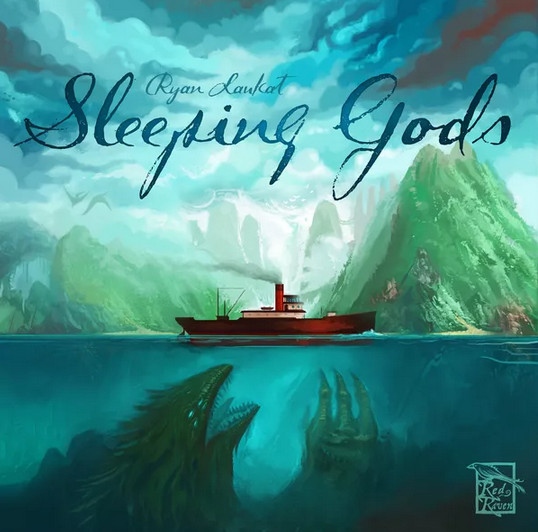
Among the titles sharing Robinson Crusoe’s cooperative survival DNA, Sleeping Gods stands apart through its atlas-based exploration system and branching narrative structure. This cooperative adventure supports 1-4 players maneuvering an open-world campaign where crew decisions permanently shape story outcomes. Players command distinct characters with specialized abilities, creating tactical depth similar to Robinson Crusoe’s role assignments but with greater narrative agency.

The game merges exploration, combat, and resource management into a seamless experience requiring constant communication and strategic planning. Unlike Robinson Crusoe’s scenario-based framework, Sleeping Gods offers nonlinear progression through interconnected islands and quests. Multiple story paths and consequential choices deliver substantial replayability, rewarding players who value autonomy over prescribed objectives. Each session unfolds differently based on player agency rather than predetermined scripts, making it ideal for groups seeking emergent storytelling within structured cooperative mechanics.
Mage Knight Overview
Mage Knight distinguishes itself from Robinson Crusoe through its deck-building core, where players construct combat engines rather than managing survival resources. This fantasy adventure demands strategic mastery across multiple systems—movement, combat, and spellcasting—while offering complete freedom through character selection. Each hero provides distinct tactical approaches, letting players forge their own path through the modular environment that reshapes itself every session.
Unlike Robinson Crusoe’s narrative survival focus, Mage Knight rewards optimization and planning over storytelling. The game scales from solo campaigns to five-player cooperative ventures, though many board games I’ve examined don’t match its mechanical depth. Resource management here emphasizes tactical card play rather than scavenging, creating a cerebral puzzle that guarantees a great time for players seeking combat-focused strategic challenges and limitless replayability through its ever-changing terrain.
The Lord of the Rings: LCG
The Lord of the Rings: Living Card Game shifts the survival framework toward cooperative deck construction with narrative progression, replacing Robinson Crusoe’s resource scarcity with threat management and quest advancement. Players customize decks using heroes, allies, and event cards to tackle modular scenarios that unfold across interconnected quest lines. The system prioritizes strategic synergy over random card draws, granting agency through pre-game preparation rather than reactive improvisation. Difficulty scaling accommodates various skill levels without constraining player choice, while thematic integration maintains Middle-earth’s atmosphere through mechanics that mirror lore. Unlike Robinson Crusoe’s isolated survival struggle, this title emphasizes team coordination across multiple scenarios, delivering replayability through deck experimentation and branching narrative paths that reward both tactical planning and long-term campaign investment.
Legends of Andor Overview
Legends of Andor (2nd Edition)
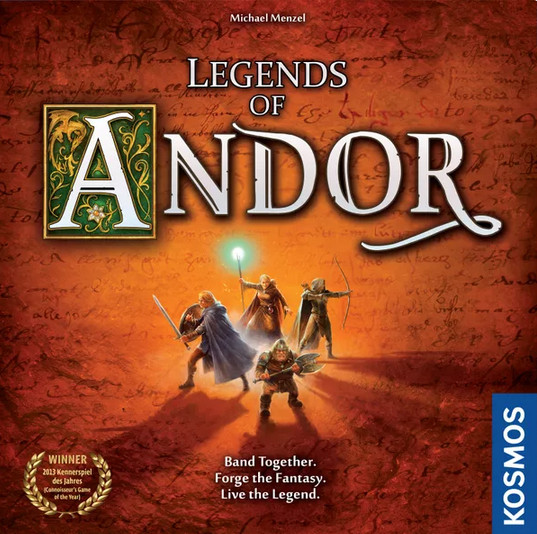
Cooperative puzzle-solving defines Legends of Andor’s mechanical identity, blending Robinson Crusoe’s survival tension with predetermined narrative structures that constrain player choices within tightly designed scenarios. The modular board shifts between legend cards, forcing teams to optimize action economy against advancing threats rather than exploring emergent sandbox possibilities. Players navigate a fantasy realm where strategic planning supersedes random revelation—each scenario presents specific challenges requiring tactical coordination, making this one of the best board games for groups seeking structured cooperative experiences. The artwork improves thematic immersion while maintaining mechanical clarity. Difficulty scaling accommodates varying skill levels, ensuring both newcomers and veterans find a lot of fun through its puzzle-focused framework. Unlike Robinson Crusoe’s brutal randomness, Andor rewards calculated risk assessment within predetermined narrative boundaries.
The Lord of the Rings: Journeys in Middle-earth Overview
App-assisted narrative integration distinguishes Lord of the Rings: Journeys in Middle-earth from purely analog cooperative adventures, automating scenario management and enemy behavior while players focus on tactical decision-making across campaign-driven quests. Each hero possesses distinct abilities that demand strategic coordination—the best plan emerges when players utilize complementary strengths against evolving threats. The game comes with branching storylines responsive to player choices, ensuring consequences ripple through subsequent missions. Test resolution employs card-based skill checks rather than dice, granting players agency through deck customization. Map exploration reveals dynamic encounters managed by the companion app, which handles enemy activation patterns and environmental effects. This hybrid approach reduces bookkeeping overhead while maintaining narrative depth comparable to Robinson Crusoe’s survival-driven tension, though substituting resource scarcity with character progression systems.
Roll Player Adventures Overview
Unlike its dice-drafting predecessor, Roll Player Adventures transforms character creation into narrative purpose through campaign-driven cooperative gameplay where player-built heroes from the original Roll Player directly influence story outcomes and mechanical advantages. The modular board reconfigures between sessions, preventing static optimization while forcing adaptive tactical approaches. Players collaborate through branching scenarios that demand puzzle-solving and strategic resource management, where choices permanently alter character progression paths. This distinguishes it from survival-focused designs, positioning it closer to narrative fantasy games with mechanical consequence systems.
| Design Element | Implementation |
|---|---|
| Board Structure | Modular tiles reconfiguring per scenario |
| Decision Impact | Branching story paths with permanent effects |
| Character Integration | Direct mechanical advantages from Roll Player stats |
| Cooperative Focus | Shared obstacle resolution and tactical planning |
| Replayability | Multiple scenario outcomes and exploratory routes |
The campaign structure creates escalating narrative investment beyond traditional card games.
Paleo Overview
Stone Age survival mechanics anchor Paleo’s cooperative framework, where players simultaneously select blind actions from individual card decks representing different tribal roles—hunters, gatherers, scouts—creating information asymmetry that demands constant communication before commitment. Unlike Robinson Crusoe’s deserted island setting, Paleo’s prehistoric environment shifts through modular scenarios that reconfigure challenge parameters across playthroughs. Resource scarcity mirrors survival genre conventions: food depletion triggers failure states, while material management gates progression toward scenario-specific victory conditions. The simultaneous action selection mechanism distinguishes it from sequential turn structures, compressing decision timeframes and intensifying cooperative tension. Each single game evolves through uncovered cards that unlock new threats and opportunities, rewarding strategic adaptation over rote planning. This design liberates players from predetermined paths while maintaining thematic coherence through era-appropriate survival pressures.