Board games sharing Mysterium’s cooperative deduction framework rely on asymmetric information distribution between players, typically featuring one participant providing abstract clues while others interpret visual or thematic elements. These titles incorporate card-based communication systems, token mechanics for tracking progress, and victory conditions dependent on collective reasoning rather than individual achievement. The genre’s mechanical foundation centers on limited communication rules, timed phases, and component-driven puzzle solving that transforms standard deduction into structured collaborative challenges requiring specific strategic approaches.
Key Takeaways
- Dixit shares Mysterium’s abstract card interpretation and asymmetric clue-giving roles with visual storytelling across 3-6 players in 30 minutes.
- Unusual Suspects offers asymmetric witness roles requiring deduction from visual clues, scaling from 3 to 18 players cooperatively.
- Hanabi provides cooperative deduction with limited communication, emphasizing logical inference rather than visual interpretation for 2-5 players.
- Wavelength combines team-based clue interpretation with spectrum placement, encouraging collaborative discussion similar to Mysterium’s cooperative atmosphere.
- 5-Minute Mystery accelerates cooperative symbol finding with time pressure, maintaining tension through quick 5-8 minute investigative sessions.
Games Similar to Mysterium
Additional cooperative deduction games offering distinct mechanical variations include:
- Rising 5: Runes of Asteros integrates app-assisted symbol deduction within a fantasy framework, delivering 20-minute sessions where players work together to decode mystical combinations.
- Stop Thief! employs digital tracking to enable pursuit mechanics, emphasizing teamwork through spatial reasoning and audio clues.
- 5-Minute Mystery accelerates hidden symbol finding to 5-8 minute sprints, maintaining cooperative pressure without extended commitment.
- Unusual Suspects transforms the deduction game format through asymmetric witness roles, scaling flexibly from intimate 3-player sessions to expansive 18-player gatherings.
Sherlock Holmes Consulting Detective


Sherlock Holmes Consulting Detective presents an investigative experience where 1-8 players collaboratively examine Victorian-era criminal cases by consulting a casebook, period newspaper, and London directory to trace leads across numbered locations. This cooperative mystery genre entry allows players work together autonomously—no turn structure restricts investigation paths. Groups gather clues and leads by selecting which locations to explore, though inefficient routes accumulate points against them when compared to Holmes’s solution. The immersive narrative rewards deduction through deep discussion, as teams must solve a murder or crime using only gathered evidence. Sessions range from two hours to full-day commitments depending on complexity of the case and thoroughness. Groups of three to four optimize the balance between diverse perspectives and manageable deliberation, though the format accommodates solo play through full eight-player sessions.
Hanabi Card Game
Hanabi (2017 Edition)

Hanabi Card Game inverts conventional card game visibility by requiring players to hold their hand facing outward, creating an information asymmetry where each participant knows everyone’s cards except their own. This cooperative deduction challenge accommodates 2-5 players who communicate through strictly limited clues to build sequential fireworks displays. Each turn permits either providing color or number information to teammates or attempting card plays based on accumulated deduction. Like Mysterium, Hanabi demands precise non-verbal strategy and interpretive teamwork, though its gameplay mechanics emphasize logical inference over intuitive pattern recognition. The constrained communication system generates substantial replay value through evolving player dynamics and variable card distributions. Winning the 2013 Spiel des Jahres validates its elegant design framework, where minimalist components produce complex strategic depth without restricting player agency or creative problem-solving approaches.
Rising 5: Runes of Asteros
Rising 5 – Runes of Asteros

Rising 5: Runes of Asteros employs an application-assisted deduction mechanism where 1-5 players collaborate to identify the correct sequence and color combination of five runes required to seal an alien portal. This cooperative deduction game challenges players to work together using limited information gathered through systematic testing of rune configurations. The companion app permits players to take pictures of their chosen arrangements, receiving cryptic feedback that guides subsequent deductions. Customizable difficulty levels provide accessibility to a wide range of skill levels while maintaining strategic depth. Success demands rigorous teamwork and communication as participants analyze clues collectively. The game offers flexibility in gameplay through optional app-free variants, though the digital integration significantly improves the interactive experience. Multiple difficulty tiers and variable portal conditions guarantee replayability while accommodating both newcomers and experienced deduction enthusiasts.
Unusual Suspects Deduction Game
Unusual Suspects streamlines social deduction into an accessible format where one player assumes the witness role while 3-17 opponents attempt to identify the culprit from a lineup of cartoon suspects. The deduction game employs straightforward gameplay mechanics reminiscent of Guess Who: players ask yes/no questions to eliminate possibilities and narrow down the thief’s identity. The witness provides clues through characteristic cards, guiding players toward the correct suspect without direct revelation. This structure facilitates rapid rounds with minimal setup, allowing groups to cycle through multiple games efficiently. Social interaction drives the experience as players collectively strategize, sharing observations and testing theories against the witness’s responses. Published in 2015, the game’s flexible player count and streamlined guessing mechanics create an accessible entry point for casual gatherings seeking light deduction challenges without complex rule overhead.
Dixit Storytelling and Guessing
Dixit (3rd Edition)
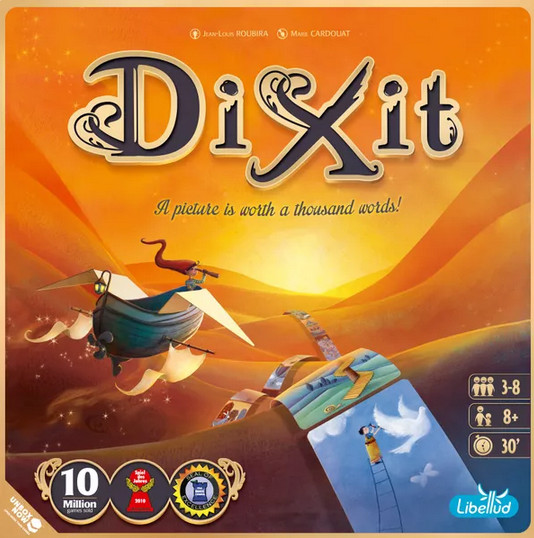
Dixit transforms abstract imagery into a competitive guessing framework where one designated storyteller per round selects a card from their hand and provides a verbal clue—ranging from single words to complete phrases or sounds—that describes the chosen illustration without revealing it directly. Other participants contribute matching cards from their own hands, forming a mixed pool that challenges deduction skills. Players vote on which beautifully illustrated cards they believe belongs to the storyteller, with scoring rewarding partial success: storytellers earn points when some—but not all—players guess correctly, while correct guessers too score. This balancing mechanism encourages collaboration through moderate clue difficulty rather than obscurity. The whimsical artwork drives creativity across casual gaming sessions, accommodating 3-6 players in approximately 30-minute matches where imagination and strategic storytelling converge.
Wavelength Party Game
Wavelength employs a rotating dial mechanism paired with spectrum cards to create opinion-based deduction challenges for 2-12 players across team-based rounds lasting approximately 30 minutes. Teams alternate between clue-giving and guessing roles, with one player providing hints that position a hidden target along various spectrum scales. The dial’s precise placement determines scoring, rewarding accurate interpretation of subjective clues. This party game demands teamwork through collaborative discussion, as teammates must decode abstract hints referencing spectrum endpoints like “cold to hot” or “underrated to overrated.” The accessible ruleset accommodates players aged 5+, ensuring broad appeal for family gatherings. Quick setup and engaging mechanics maintain momentum across rounds, while the spectrum-based structure encourages creative communication strategies. Two-team competition creates dynamic tension, making each guessing attempt consequential for final scoring outcomes.
Betrayal at House on the Hill
The modular tiles system guarantees exceptional replayability, as room configurations never repeat exactly. Each scenario delivers distinct win conditions and mechanical rulesets, requiring players to adapt strategies mid-game. Thematic storytelling emerges organically through card-driven encounters and haunt narratives. Player interaction intensifies after the betrayal, demanding tactical communication among investigators while the traitor executes their secret agenda. This mechanical freedom allows diverse approaches to uncovering the mansion’s secrets.