Love Letter establishes a deduction framework through sixteen cards and single-round elimination mechanics. Players manipulate hidden information while targeting opponents based on incomplete knowledge of card distribution. The game’s success stems from its compressed decision trees and immediate consequence structure. Similar titles expand these core mechanics through varied win conditions, extended player counts, and modified bluffing elements. Understanding these mechanical variations reveals ideal strategies for selecting games that maintain Love Letter’s tactical depth while introducing fresh strategic challenges.
Key Takeaways
- Quick deduction games like Coup and Lost Legacy offer similar 15-30 minute sessions with bluffing and elimination mechanics.
- Social deduction titles emphasize hidden roles, information manipulation, and psychological gameplay through streamlined rulesets for larger groups.
- Lost Legacy uses systematic card elimination and deduction to identify target holders, mirroring Love Letter’s process-of-elimination structure.
- Citadels features secret role selection and character abilities that create deduction opportunities in longer 30-60 minute sessions.
- Games focusing on incomplete information, risk assessment, and tactical card management provide comparable strategic depth and engagement.



Quick Deduction Card Games
Quick deduction card games operate on a foundation of incomplete information and logical inference, where players must deduce hidden elements through systematic observation and strategic card play. These games excel through constrained decision spaces and limited card pools, forcing players to extract maximum value from minimal resources.
Core mechanical elements that define similar games:
- Information asymmetry – Players possess partial knowledge while inferring opponents’ holdings
- Process of elimination – Systematic reduction of possibilities through revealed cards and player actions
- Risk assessment – Calculated decisions based on probability and observed behaviors
- Timing optimization – Strategic deployment of cards for maximum tactical advantage
Quick deduction card games maintain engagement through compressed play sessions and immediate consequences, where single decisions cascade into victory or elimination within 20-30 minute timeframes.
Coup: Bluffing and Deduction
Coup by Indie Boards & Cards
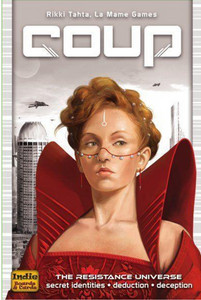
Every player in Coup begins with two influence cards and two coins, creating a foundation of hidden information where successful deduction requires parsing genuine claims from calculated bluffs. The 15-card deck contains three copies each of Ambassador, Assassin, Captain, Contessa, and Duke, with each role granting specific actions that opponents may challenge. Successful challenges force card loss, while failed challenges backfire on the challenger. Players must balance aggressive moves with defensive positioning, using income generation, blocking abilities, and elimination attempts strategically. Unlike Love Letter’s process of elimination through card tracking, this card game emphasizes psychological warfare and risk assessment. Victory requires reading opponents’ behavioral patterns while maintaining believable deceptions across multiple rounds of escalating tension.
Lost Legacy: Deduction Elimination
Lost Legacy operates through a sixteen-card deck where each player receives one card and attempts to deduce which opponent holds the titular Lost Legacy card through systematic elimination and information gathering. Players execute actions based on their card’s abilities, forcing opponents to reveal information or discard cards. The deduction process requires analyzing revealed cards against the known deck composition, systematically narrowing possibilities until the Lost Legacy holder becomes apparent.
Victory occurs when a player correctly identifies the Lost Legacy holder or survives as the final player holding it. The elimination mechanics create mounting pressure as fewer players remain, intensifying the deduction challenge. Strategic timing governs when players reveal information versus withholding critical knowledge. Multiple thematic variations provide distinct card sets and special rules, maintaining fresh gameplay experiences while preserving the core elimination framework.
Citadels: Role Selection Mystery
Citadels (Revised Edition)
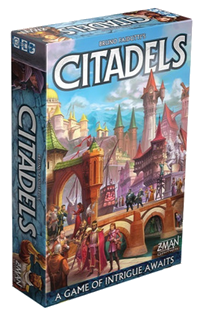
Citadels transforms role selection into a psychological battlefield where players secretly choose character cards that determine turn order and available actions for each round. Each character possesses distinct abilities that can accelerate building construction, eliminate opponents, or manipulate game flow. Players must deduce opponents’ character selections while concealing their own choices, creating layered strategic depth.
| Character Type | Primary Ability | Strategic Focus |
|---|---|---|
| Assassin | Eliminates chosen character | Control/Disruption |
| Thief | Steals gold from target | Resource Denial |
| Architect | Draws/builds extra cards | Acceleration |
The deduction mechanics mirror Love Letter’s hidden information gameplay, requiring players to analyze opponents’ actions and timing. Strategic role selection becomes paramount as character abilities directly influence victory conditions. Games accommodate 2-8 players across 30-60 minute sessions, providing tactical freedom without excessive time investment.
Social Deduction Party Games
While character-based deduction forms the foundation of strategic gameplay, social deduction party games expand this concept by placing hidden roles and secret information at the center of group dynamics. These board games empower players to manipulate information through bluffing, deception, and strategic misdirection. Titles like “Coup” and “The Resistance” exemplify this genre’s mechanics, where players must simultaneously conceal their true identities while exposing others’ hidden motives through structured discussion phases and accusation rounds.
The genre’s accessibility stems from streamlined rulesets that accommodate 5+ players within 15-30 minute sessions. Social deduction mechanics create emergent gameplay where psychological manipulation and verbal persuasion determine victory conditions. Players exercise complete autonomy over their deceptive strategies, making each session unpredictable and player-driven rather than constrained by rigid mechanical frameworks.
Jaipur: Trading Card Tactics
Jaipur transforms commodity trading into precise tactical exchanges through its dual-action economy system. Players execute binary choices each turn: acquire cards from the central market or liquidate goods for immediate profit. The trading card mechanism creates resource scarcity through limited market availability, forcing calculated risk assessment.
Strategic depth emerges from good valuation differentials. Premium commodities like gold and diamonds yield higher returns but require larger hand commitments, while basic goods provide steady income streams. Players must monitor opponent collections to deny profitable sales opportunities.
Quick gameplay sessions demand aggressive tempo management. The 20-minute format eliminates lengthy deliberation, rewarding instinctive market reads over prolonged analysis. Victory requires balancing immediate liquidity against speculative accumulation, as market conditions shift through opponent actions and deck composition changes.
Skull: Bluffing Rose Game
Skull operates through a dual-phase elimination system where players navigate psychological warfare using identical four-card hands containing three roses and one skull. During placement phases, participants secretly select and position cards facedown, establishing the foundation for subsequent bidding rounds. The auction mechanism requires players to declare how many cards they can reveal without encountering skulls, creating escalating tension through competitive declarations.
Bluffing becomes crucial when players must decide whether to place skulls or roses, knowing opponents will attempt to call their deceptions. Failed bids result in card elimination, reducing player resources until elimination occurs. The challenge system allows direct confrontation between participants, enabling strategic takedowns of perceived threats. This streamlined design delivers concentrated psychological combat within thirty-minute sessions, demanding constant risk assessment and opponent analysis.
Sushi Go: Drafting Strategy
Sushi Go transforms competitive tension from direct confrontation into simultaneous card selection, implementing a drafting mechanism where players receive hands of seven cards and choose one before passing the remainder clockwise. Unlike games like Love Letter where players maintain one card in hand, Sushi Go requires evaluating multiple combinations across three rounds. Players accumulate sushi cards pursuing set collection objectives: maki rolls compete for majority scoring, sashimi demands exact three-card sets, and tempura rewards pairs. Strategic depth emerges through information deduction as players track circulating cards and anticipate opponents’ collection goals. The drafting process creates interdependent decision-making where blocking opponents becomes as essential as personal optimization. Each 20-minute session accommodates 2-5 players seeking tactical card management without elimination mechanics.
Team Building Card Choices
While traditional Love Letter mechanics emphasize individual deduction and elimination, team-based variants introduce collaborative card selection where partners must coordinate their character choices to maximize shared information and strategic positioning. Team building card choices similar to Love Letter require players to balance individual card power with collective strategic value. Partners must communicate through legal gameplay actions, using character abilities to signal intentions and protect teammates. The Guard’s probing function becomes reconnaissance for the team, while the Baron facilitates information sharing between allies. Handmaid protection extends beyond self-preservation to shield vulnerable partners. Success depends on synchronized timing—coordinating Princess safety, optimizing Priest revelations, and executing King swaps that benefit team positioning rather than individual advancement.