Players seeking alternatives to Firefly encounter numerous space-themed board games that emphasize crew management, ship customization, and strategic resource allocation. Merchant of Venus delivers economic trading mechanics with modular board configurations. Xia: Legends of a Drift System implements open exploration through tactical movement and equipment upgrades. Outer Rim focuses on reputation building and cargo smuggling objectives. Each title requires careful consideration of risk-versus-reward calculations and ideal loadout configurations that determine mission success rates and victory conditions.


Key Takeaways
- Merchant of Venus offers customizable starships, trade networks with alien civilizations, and strategic cargo management across modular galaxy boards.
- Xia: Legends of a Drift System provides open-world sandbox gameplay with trading, piracy, exploration, and modular ship customization systems.
- Outer Rim: Smuggler Adventures features structured pick-up-and-deliver missions with simplified combat resolution and streamlined navigation mechanics.
- Betrayal at House on the Hill delivers asymmetric cooperation with modular exploration, mid-game haunt activation, and fifty unique scenarios.
- Games emphasize strategic decision-making through resource management, crew dynamics, equipment customization, and multiple victory paths for replayability.
Space-themed Adventure Board Games
How do space-themed adventure board games capture the strategic complexity that makes Firefly: The Game compelling? These titles emphasize exploration, resource management, and strategic decision-making that grant players autonomy over their galactic destinies. Each strategy game delivers mechanical depth through interconnected systems demanding careful planning and tactical execution.
Core mechanics that define exceptional space-themed adventure board games include:
- Dice rolling and worker placement – Adding probabilistic elements and resource competition
- Narrative building – Enabling players to craft unique stories within established universes
- Resource management – Balancing acquisition, allocation, and strategic reserves
- Cooperative elements – Requiring working together while maintaining competitive objectives
Games like Star Wars: Outer Rim, Eclipse, Terraforming Mars, and Gaia Project exemplify these principles. Their mechanical complexity creates high replayability through varied outcomes, ensuring each session presents fresh strategic challenges for players seeking galactic freedom.
Merchant of Venus
Merchant of Venus By Fantasy Flight Games
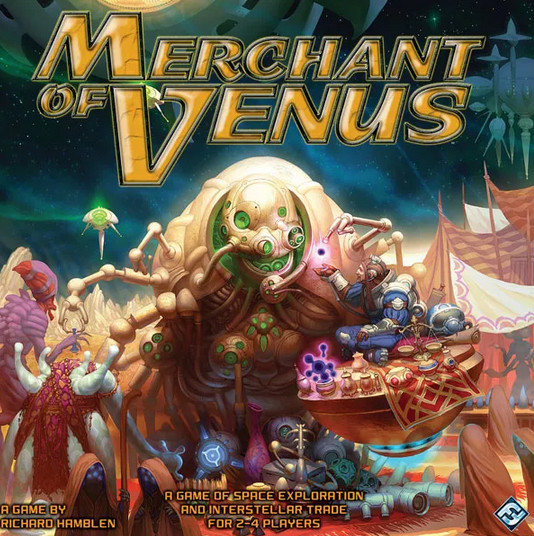
Galactic commerce drives the strategic foundation of Merchant of Venus, where players pilot customizable starships across a modular galaxy board to establish profitable trade networks with diverse alien civilizations. This adventure game delivers tactical decision-making through its dual movement system: predetermined hyperspace routes for efficiency or open exploration for revelation opportunities. Players negotiate with unique alien species, each providing distinct trading advantages and mechanical benefits that reshape strategic approaches. The deck of cards introduces variable events and encounters, balancing calculated risk assessment with adaptable planning. Victory emerges through optimized cargo management, route efficiency, and alien relationship cultivation. Board games enthusiasts appreciate the system’s emphasis on economic engine-building over combat, creating sustained tension through market manipulation and resource scarcity rather than direct conflict mechanics.
Xia: Legends of a Drift System
Xia – Legends of a Drift System

Freedom defines the core mechanical framework of Xia: Legends of a Drift System, where one to five players command starships through an open-world sandbox that prioritizes emergent gameplay over predetermined victory conditions. Unlike traditional worker placement games that constrain player actions, Xia liberates captains to pursue trading, piracy, or exploration simultaneously. The modular ship customization system facilitates strategic adaptation, while the reputation mechanism creates consequential decision-making without restrictive alignment penalties. Victory emerges through multiple paths: accumulating fame points via missions, trading profits, or combat victories. Card games typically limit strategic depth through hand management, but Xia’s open-world structure removes such constraints. Sessions spanning 2-4 hours accommodate complex strategic development, allowing players complete autonomy over their spacefaring destiny within this mechanically robust framework.
Outer Rim: Smuggler Adventures
While Xia emphasizes sandbox freedom, Outer Rim: Smuggler Adventures constrains player agency within a structured pick-up-and-deliver framework that prioritizes narrative momentum over strategic depth. This Star Wars-themed game streamlines complex mechanics found in Firefly, reducing combat, movement, and skill tests to accelerate decision-making cycles.
| Mechanic | Outer Rim | Firefly |
|---|---|---|
| Combat Resolution | Simplified dice system | Multi-step engagement |
| Movement | Streamlined navigation | Complex travel mechanics |
| Crew Management | Basic crew members | Detailed character development |
| Mission Structure | Linear delivery routes | Open-ended job selection |
The game sacrifices Firefly’s strategic complexity for accessibility, offering 1-4 players expedited gameplay sessions. Solo mode includes competitive AI, eliminating multiplayer dependency while maintaining scoring pressure through automated opposition mechanics.
Betrayal at House on the Hill
Betrayal at House on the Hill (2nd Edition)

Betrayal at House on the Hill plunges from Firefly’s space-trading framework through asymmetric cooperation mechanics that fundamentally restructure player objectives mid-game. Players navigate modular mansion tiles, accumulating items and triggering events until haunt activation transforms one participant into an active antagonist. The game set delivers fifty distinct scenarios, each establishing unique victory conditions and strategic parameters. Unlike Firefly’s consistent crew dynamics, Betrayal fractures alliances instantly—cooperative investigation becomes competitive survival. Card draws and dice rolls generate unpredictable narrative branches, while the traitor gains exclusive rulebook access defining their hidden objectives. Time pressure escalates as remaining players coordinate counter-strategies against increasingly powerful opposition. This mechanical shift from unified goals to adversarial gameplay mirrors Firefly’s tension between crew loyalty and individual survival when circumstances deteriorate.
Find the perfect alternative to Betrayal at House on the Hill for your next game night.
Cowboy Bebop: Space Serenade
Cowboy Bebop: Space Serenade translates the anime’s bounty hunting framework into deck-building mechanics where players construct card engines to optimize mission completion and capture efficiency. Each character operates with asymmetric abilities that mirror their source material personalities, creating distinct strategic pathways. Players navigate competitive bounty acquisition while managing hand resources and deck composition simultaneously.
The 60-90 minute playtime accommodates 2-4 players pursuing independent objectives across galactic missions. Unlike cooperative experiences where teams work together, this card game emphasizes individual optimization and tactical positioning. Players must balance immediate tactical gains against long-term deck improvement strategies. The mechanical depth rivals complex systems found in Marvel Heroes adaptations, demanding careful resource allocation and timing decisions. Strategic depth emerges through character synergies and mission selection, requiring players to adapt their approaches based on opponent movements and available opportunities.
Shadowrun: Crossfire Cooperative Deck-Building
Shadowrun: Crossfire transforms the cyberpunk universe into a cooperative deck-building system where four shadowrunners must synchronize card acquisitions and tactical deployments across escalating mission scenarios. Players construct decks representing skills, equipment, and spells while managing resources against corporate threats. Each character role offers distinct abilities, enabling teams to customize strategic approaches based on mission parameters. The cooperative framework demands precise coordination as obstacle difficulty increases throughout scenarios. Deck optimization becomes critical when facing magical and technological adversaries requiring specific countermeasures. Teams must balance individual character development with collective strategic objectives, purchasing cards that complement teammate capabilities rather than pursuing independent advancement. Success depends on tactical communication and resource allocation efficiency. The cyberpunk setting provides narrative context while mechanical systems emphasize teamwork over individual achievement, creating engaging strategic depth.
Crews and Ship Customization
Players assemble crews and outfit ships through strategic selection systems that directly impact mission success rates and tactical flexibility. Firefly: The Game allows strategic crew recruitment from canonical characters, each contributing distinct skill sets that synergize with specific mission parameters. Ship customization through gear acquisition creates tactical loadout decisions that determine operational capabilities across diverse job types.
The Blue Sun expansion increases customization depth by introducing advanced components and strategic equipment options. Players must balance crew abilities against ship modifications to optimize performance matrices for different operational scenarios. Effective combinations unlock improved navigation capabilities and mission completion probabilities.
Firefly: Misbehavin extends customization through faction-based deck construction, reflecting unique ship and crew dynamics. Strategic outfitting decisions create emergent gameplay paths, allowing players to pursue specialized operational approaches while maintaining adaptive flexibility for unexpected challenges and opportunities.