Arkham Horror stands as a cornerstone in the pantheon of cosmic dread tabletop experiences. The game’s intricate mechanics reveal the inevitable encroachment of eldritch entities upon our fragile reality. Numerous spiritual successors have emerged from this sanity-testing template, each offering distinct variations on cooperative play against unknowable horrors. From global-spanning investigations to condensed confrontations with Ancient Ones, these alternatives present unique mechanical approaches to existential terror. What follows are the most worthy inheritors of Arkham’s unspeakable legacy.
Key Takeaways
- Eldritch Horror offers global Lovecraftian exploration with streamlined mechanics and similar cooperative gameplay to Arkham Horror.
- Cthulhu: Death May Die provides a faster-paced cosmic horror experience with tactical sanity management and scenario variety.
- Mansions of Madness combines app-driven mechanics with physical components for an immersive, collaborative investigation experience.
- Mysterium creates unique cooperative gameplay through abstract vision interpretation as players collectively solve a paranormal mystery.
- Castle Ravenloft transfers cooperative horror mechanics to a medieval setting with modular dungeons and episodic scenarios.
Lovecraftian Cooperative Experiences
While Arkham Horror stands as the progenitor of the modern Lovecraftian board game renaissance, a pantheon of cooperative titles has emerged to investigate the fathomless depths of cosmic horror through varied ludic mechanisms. The mysterious appeal of facing unfathomable entities collectively has brought forth games that demand strategic synchronicity and existential fortitude.
- Cthulhu: Death May Die employs revolutionary sanity mechanics that transform psychological deterioration into tactical opportunities
- Narrative immersion serves as both aesthetic foundation and mechanical framework in these eldritch pursuits
- Resource allocation and action economy become communal puzzles rather than solitary endeavors
- Multi-layered strategic depth emerges through shared decision matrices and consequence management
- Randomized elements guarantee the cosmic void remains perpetually inscrutable, encouraging unlimited explorations
These cooperative endeavors transcend mere entertainment, becoming ritualistic experiences where players collectively navigate the thin membrane between comprehension and madness.
Eldritch Horror Mythos Exploration
Expanding beyond the confines of a single haunted municipality, Eldritch Horror unfurls a global tapestry of cosmic dread across which investigators must traverse to combat pan-dimensional threats. This cooperative board game reveals the quintessential Lovecraftian framework through its modular construction, facilitating multifarious permutations of Ancient Ones and narrative arcs.
Each investigator embodies unique metaphysical attunements and specialized aptitudes, compelling players to orchestrate their collective faculties while maintaining precarious balance between sanity and oblivion. The game’s streamlined action economy permits unencumbered exploration of the mythos, with each location harboring cryptic encounters that test one’s resolve against eldritch machinations.
The extensive pantheon of expansions further enhances the experience, introducing additional investigators and cosmic entities, thereby exponentially increasing the game’s intricate tableau of existential horror and strategic camaraderie.
Cthulhu: Death May Die
Unlike its methodical elder siblings in the Lovecraftian ludological pantheon, Cthulhu: Death May Die accelerates the confrontation with cosmic horror through its temporally condensed gameplay architecture. This horror card game eschews protracted narrative for immediate eldritchian engagement, where 1-5 investigators manipulate their sanity threshold to access transcendent capabilities—a metaphysical risk-reward calculation that exemplifies the game’s psychological depth.
| Ludic Element | Mechanical Function | Experiential Outcome |
|---|---|---|
| Sanity Mechanics | Progressive power/degeneration | Tactical sacrifice |
| Scenario Variability | Randomized configurations | Perpetual novelty |
| Miniature Aesthetics | Tactile immersion | Amplified dread embodiment |
The game’s brilliant compression of the Cthulhu mythos into accessible temporal segments represents a model evolution in cooperative horror gaming—retaining thematic integrity while acknowledging contemporary players’ chronological constraints. Its scenario diversity guarantees intellectual engagement persists beyond initial confrontations with the Ancient Ones.
Mysterium’s Haunting Seance Gameplay
Mysterium reveals a paranormal communicative model that subverts traditional board game interactivity through its hauntological framework. This cooperative experience positions one player as a spectral entity constrained by the ontological limitations of the afterlife—unable to vocalize yet compelled to communicate through puzzling card imagery. The resulting hermeneutic exercise demands investigators collectively decode these abstract visions to identify the correct suspect, location, and murder weapon.
The game’s extraordinary communicative asymmetry—where the ghost player transmits knowledge through beautifully illustrated card tableaux—creates a phenomenological puzzle space accessible to gatherings of 2-7 participants. This dialogic tension between the expressively constrained ghost and the interpretive freedom of investigators reveals a unique ludic structure reminiscent of Arkham Horror’s atmospheric immersion, yet distinctly focused on interpretive collaboration rather than eldritch combat—all within a concentrated 45-60 minute séance experience.
Tense Ghost Stories Gameplay
Where Arkham Horror deploys cosmic horror through sprawling narrative permutations, Ghost Stories brings forth existential dread through mechanically elegant siege dynamics. This cooperative framework transmutes players into Taoist priests defending a village against spectral invaders, requiring synchronized tactical maneuvers rather than individualistic heroics.
Ghost Stories’ reputation for punishing difficulty emerges from its relentless pressure system—a carefully calibrated algorithm of ghost occurrences that consistently threaten to overwhelm the village’s fragile balance. Unlike many solo card experiences, Ghost Stories demands ruthless resource optimization amid escalating supernatural chaos.
The game’s aesthetic dimensions—richly illustrated specters and thematic components—elevate the experience beyond mere tactical challenge into immersive theater. Each session unfolds as a unique defensive narrative, with randomized ghostly appearances ensuring perpetual novelty within its tightly designed resistance framework.
Mansions of Madness Gameplay
Mansions of Madness (2nd Edition)
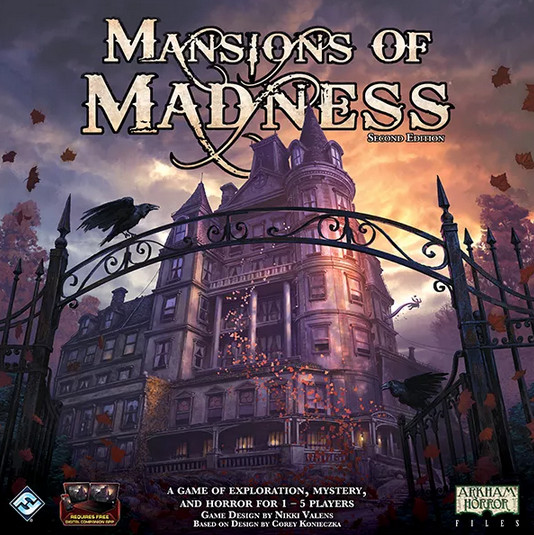
Every haunted corridor within Mansions of Madness represents a digital-physical hybridization that transcends conventional board game frameworks. The app-driven mechanics orchestrate an unparalleled narrative tapestry, liberating players from the constraints of static gameplay while maintaining the tactile satisfaction of physical components.
| Ludic Element | Mechanical Implementation |
|---|---|
| Digital Nexus | App-directed narrative progression |
| Investigative Protocol | Collaborative clue revelation |
| Character Matrix | Asymmetrical ability distribution |
| Sanity Balance | Progressive psychological deterioration |
| Scenario Topology | Branching narrative architecture |
While Horror: The Card Game emphasizes deck construction, Mansions of Madness delivers a more spatially-oriented experience. The digital overseer crafts uniquely responsive scenarios, ensuring no two expeditions into eldritch territory appear identically. This algorithmic unpredictability, coupled with diverse investigator archetypes, establishes a cosmos of possibilities within the mansion’s constantly transmuting architecture.
Resident Evil 2 Scenario
How precisely does Resident Evil 2’s tableau of survival horror transpose the Lovecraftian dread of Arkham Horror into a modern apocalyptic framework? This cooperative ludic experience achieves this transmutation through meticulously calibrated stealth mechanics, positioning players in a precarious balance between exploration and preservation.
The game’s architectural genius reveals itself in its modular topography, offering permutations reminiscent of Escape the Dark Castle’s mutable environments. Players navigate interconnected locations while deciphering cryptic puzzles—a direct parallel to Arkham’s investigative ethos. The ingenious “zombie spawn” mechanism functions as an escalating clock of inevitability, creating sustained psychological tension among participants.
Unlike many board games in this genre, Resident Evil 2’s immersive scenarios demand collaborative strategic calculus. Players assuming iconic avatars must orchestrate their collective abilities to survive Raccoon City’s necrotic maze, echoing Arkham’s imperative for tactical symbiosis amid cosmic horror.
Castle Ravenloft D&D Adventure
The Gothic maze of Castle Ravenloft offers an apotheosis of collaborative dungeoneering that transmutes Arkham Horror’s eldritch framework into a crystalline distillation of high fantasy peril. This dungeon crawler eschews the mythos-laden paranoia of Arkham Horror LCG for medieval phantasmagoria, yet preserves the fundamental cooperative model that aficionados cherish.
The game’s architectural brilliance lies in its modular tessellation—players construct the intricate stronghold through emergent exploration, with each expedition yielding distinct cartographical permutations. One-to-five heroes, each possessing unique capabilities, navigate this transmutable nightmare while accruing power through traditional RPG progression mechanics.
Unlike Arkham’s narrative permanence, Ravenloft offers discrete scenarios with autonomous resolution, allowing episodic engagement rather than campaign commitment. The integration of canonical D&D antagonists—vampiric lords and ambulatory cadavers—provides thematic coherence while challenging players’ tactical acumen through resource management and collective strategy.