Christmas-themed board games require careful evaluation of mechanics that balance holiday atmosphere with strategic depth. Worker placement titles like Santa’s Workshop demand resource management while maintaining thematic coherence. Card-driven games such as 12 Days integrate festive elements into victory conditions without sacrificing tactical decision-making. The most successful holiday games avoid relying solely on theme, instead incorporating seasonal elements into core gameplay loops. Strategic players must consider how Christmas mechanics affect ideal play patterns and whether festive components improve or distract from competitive balance.
Key Takeaways
- “12 Days” combines trick-taking and set collection mechanics for tactical gameplay ideal for strategic holiday gatherings.
- “Santa’s Workshop” features sophisticated worker-placement dynamics where players optimize elf deployment across multiple production stations.
- “Holiday Fever” offers fast-paced party mechanics with simultaneous action selection, perfect for inclusive family engagement.
- “Elf Snowball Showdown Cards” provides competitive strategic depth with streamlined rules suitable for all family ages.
- “Frosty Follow the Leader” introduces cooperative mechanics for ages 4+ that eliminate player elimination and promote teamwork.
Top Holiday Gaming Picks
Several Christmas-themed board games deliver strategic depth through diverse mechanical frameworks that cater to different player preferences and skill levels. “12 Days” employs dual-layered mechanics combining trick-taking with set collection, requiring players to balance immediate tactical gains against long-term scoring optimization based on the twelve gifts from the classic carol. “Merry Grinchmas!” utilizes cooperative problem-solving mechanics where players must coordinate actions and resource management to achieve shared objectives within time constraints. “Ghosts of Christmas” implements variable player powers within its trick-taking structure, demanding careful hand management and prediction of opponent behavior across multiple rounds.
- Pathway Navigation – “Elf: Journey from the North Pole Game” features unique route-building mechanics
- Film Knowledge Testing – “A Christmas Story: The Party Game” challenges trivia mastery
- Creative Expression – “Christmas Charades” emphasizes improvisational performance skills
- Visual Communication – “Holiday Pictionary” rewards artistic interpretation abilities
Santa’s Workshop Worker Placement
Santa’s Workshop (2017)
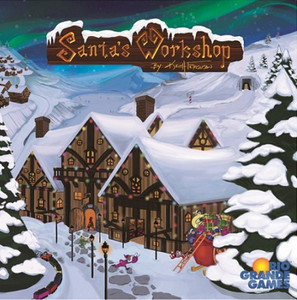
While most Christmas board games prioritize thematic immersion over mechanical complexity, Santa’s Workshop delivers sophisticated worker-placement dynamics that challenge players to optimize elf deployment across multiple production stations. Designer Keith Ferguson crafted a system where strategic elf training directly impacts toy manufacturing efficiency, creating meaningful decision trees each turn. Players must balance immediate production needs against long-term workforce development, as trained elves unlock advanced crafting opportunities. The core mechanics revolve around resource allocation and timing optimization, demanding careful planning to maximize output while competitors vie for limited workshop spaces. This strategic depth distinguishes Santa’s Workshop from typical holiday-themed board games, offering genuine tactical choices beneath its festive veneer. The upcoming second edition promises refined mechanics for improved strategic play.
Holiday Fever Party Game
Holiday Fever shifts the Christmas gaming experience from strategic optimization to fast-paced party mechanics, where players race through holiday preparation tasks using simultaneous action selection and real-time challenges. This holiday fever party game implements concurrent gameplay where participants execute Christmas activities like shopping, tree-decorating, and gift-giving without traditional turn restrictions. The mechanics eliminate downtime through parallel processing, allowing families unrestricted engagement regardless of age differences. Players navigate festive tasks through direct competition rather than controlled resource management. The system prioritizes accessibility over complexity, removing barriers that typically constrain family participation in Christmas games. Designer Evan Mark Shelline’s approach favors immediate gratification and inclusive mechanics, positioning the game as an unrestricted holiday tradition that accommodates varying skill levels while maintaining competitive tension through time-pressured decision-making.
12 Days Card Game
12 Days By Calliope Games
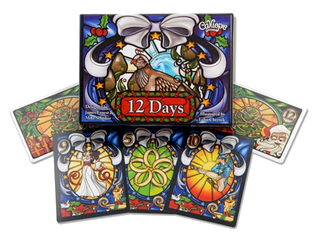
The game accommodates ages seven and up, creating competitive dynamics across generational boundaries without sacrificing strategic depth. Quick rounds preserve momentum during holiday gatherings while maintaining meaningful decision points throughout play.
Victory requires balancing immediate trick-taking opportunities against building valuable Christmas-themed sets. Players must evaluate when to commit high cards for tricks versus preserving them for collection objectives. The elegant design streamlines complex interactions, allowing strategic focus without mechanical overhead. This dual-path approach creates multiple viable strategies, encouraging repeated plays as participants investigate different tactical approaches to mastering both game systems simultaneously.
Ghosts of Christmas Strategy
Building on trick-taking fundamentals, Ghosts of Christmas improves traditional card mechanics through its literary-inspired character system and temporal ghost framework. Players utilize Dickens characters like Tiny Tim and Scrooge while maneuvering through past, present, and future ghost influences that modify standard trick-taking rules. Strategic success requires balancing offensive card plays against defensive positioning, as opponents attempt counterplays through character abilities and ghost interventions.
The game’s core strategy revolves around timing character deployments while anticipating ghost effects that can dramatically shift trick outcomes. Players must evaluate hand strength against available character synergies, creating multiple decision layers beyond conventional trick-taking games. Critical thinking becomes crucial when determining whether to pursue immediate tricks or establish long-term positional advantages through character combinations and ghost manipulation timing.
Animal Upon Animal Christmas
Dexterity and spatial reasoning converge in Animal Upon Animal Christmas, where players execute precise stacking maneuvers using festive wooden animal pieces across an unstable tower foundation. The core mechanics demand calculated risk assessment as participants strategically place Christmas-themed animals while maintaining structural integrity. Each turn presents tactical decisions: selecting ideal animal orientation, identifying stable contact points, and exploiting opponents’ precarious placements. Victory conditions require complete piece elimination through successful stacking sequences.
The ruleset accommodates 2-4 players aged four and above, establishing accessible entry barriers while maintaining competitive depth. Fine motor skill development occurs naturally through repeated manipulation of three-dimensional wooden components. Strategic elements emerge from forced placement scenarios where players must navigate increasingly challenging tower configurations. Animal Upon Animal Christmas transforms traditional stacking mechanics into engaging holiday entertainment that rewards precision over chance-based outcomes.
Grinch Heart Growing Card Game
Shifting from physical dexterity challenges to card-based mechanics, Grinch Heart Growing Card Game transforms cooperative gameplay into a structured system where players advance through kindness-oriented objectives to achieve collective victory conditions. This card game establishes strategic frameworks where participants ages 8+ select from challenge cards requiring generous actions rather than competitive elimination. Players accumulate heart growth tokens through completing kindness tasks, creating measurable progress toward shared goals. The mechanics emphasize collaborative decision-making over individual advancement, allowing groups to determine effective challenge distribution based on player capabilities. Victory emerges through collective heart expansion rather than singular dominance. Strategic elements include resource allocation timing and challenge sequence effectiveness. The system rewards cooperative planning while maintaining accessible rules structures that accommodate mixed-age groups seeking structured holiday entertainment without restrictive competitive hierarchies.
Elf Snowball Showdown Cards
While cooperative mechanics define the previous entry, Elf Snowball Showdown Cards establishes competitive frameworks through strategic card deployment where players ages 7+ engage in elimination-based combat scenarios using snowball-themed attack and defense mechanisms. The game accommodates 3-5 participants in fast-paced rounds requiring tactical card selection and opponent prediction. Players must balance offensive snowball attacks against defensive positioning while managing limited hand resources. The streamlined ruleset eliminates complex interactions, enabling quick decision-making without sacrificing strategic depth. Victory conditions center on outlasting opponents through superior card timing and resource management. Elf Snowball Showdown Cards delivers accessible competitive gameplay that rewards planning over chance, making it suitable for families seeking strategic Christmas entertainment without overwhelming younger participants with excessive complexity.
Frosty Follow the Leader
Moving from elimination-based competition to collaborative puzzle-solving, Frosty Follow the Leader introduces cooperative mechanics where players ages 4+ unite to sequence character cards through coordinated matching systems. This Frosty the Snowman adaptation eliminates player elimination, instead requiring collective decision-making to achieve shared objectives.
The core mechanism centers on systematic character ordering, where participants must coordinate their card selections to maintain proper sequences. Victory depends entirely on group consensus and strategic communication rather than individual dominance. The game’s accessibility allows younger participants to contribute meaningfully while providing sufficient complexity to engage experienced players.
Strategic depth emerges through pattern recognition and collaborative planning. Players must analyze available options collectively, making tactical decisions that benefit the entire group. This cooperative framework transforms traditional competitive card mechanics into team-based puzzle-solving, emphasizing collective problem-solving over individual achievement.